

Fall Protection Equipment Supplier
Built Around Safer Work at Height
Working at height requires more than a single piece of protective equipment. A suitable fall-protection arrangement considers the worker, the task, the height, movement required, anchorage, connecting equipment, and potential rescue requirements.
Sohum Industrial Sales Corporation is a dependable Fall Protection Equipment Supplier in West Bengal, Kolkata, Odisha, Chhattisgarh, Bihar, Arunachal Pradesh, Assam, Manipur, Meghalaya, Mizoram, Nagaland, Tripura and Bhutan providing work-at-height safety solutions for construction, industrial maintenance, infrastructure, telecom, electrical, roofing, engineering, and utility applications.
What Is Fall Protection Equipment?
Fall Protection Equipment refers to personal protective and associated equipment used to help prevent falls from elevated work areas or reduce the consequences of a fall when prevention is not reasonably achievable. Depending on the work situation, a fall-protection system may incorporate equipment such as harnesses, lanyards, lifelines, anchorage connectors, self-retracting devices, positioning equipment, and related accessories. The equipment must be selected and used as part of an appropriate fall-protection system rather than treated as an independent solution.
Protection for Different Tasks
Work-at-height activities are not identical. A technician climbing a telecom tower has different movement requirements from a worker installing roofing sheets or maintaining an industrial structure.
Fall-protection equipment can support applications involving:
- Tower climbing
- Structural maintenance
- Roofing work
- Elevated construction
- Electrical maintenance
- Solar installation
- Industrial plant servicing
- Bridge maintenance
- Steel erection
- Warehouse work at elevated levels
- Telecom infrastructure
- Utility maintenance
- Inspection and repair activities
Components of a Fall Protection System
A complete system may include several compatible components.
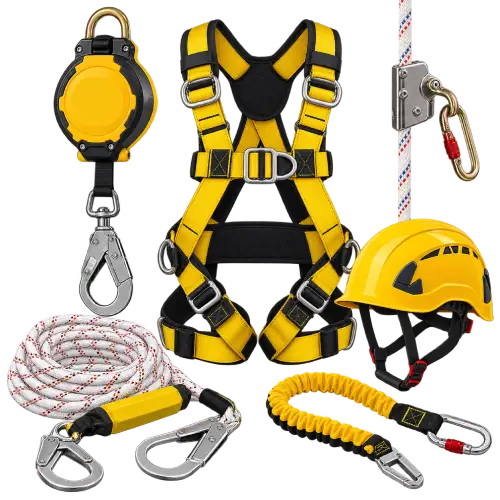
- Full-Body Harness
The harness provides the main body interface and is commonly used with fall-arrest systems. Its attachment points must be used only for their specified purposes.
- Energy-Absorbing Lanyard
An energy-absorbing lanyard is designed for appropriate fall-arrest applications and incorporates an energy-absorbing element intended to limit fall-arrest forces when used correctly.
- Twin-Leg Lanyard
A twin-leg configuration can support continuous connection during certain climbing or movement activities, provided it is used according to the manufacturer’s instructions.
- Lifeline Systems
Lifelines can provide a connection route for workers moving along designated work areas. Different systems are available for different movement patterns and applications.
- Anchorage Connectors
Anchorage equipment provides a connection between the fall-protection system and a suitable anchorage point. The anchorage must be appropriate for the intended system.
- Self-Retracting Lifelines
These devices allow controlled movement while maintaining a connection to the worker and can be suitable for specified fall-protection applications.
Fall Prevention vs Fall Arrest
Understanding this difference is important.
Fall Prevention focuses on stopping a worker from reaching a location where a fall could occur. Guardrails, barriers, travel-restraint systems, and suitable positioning arrangements can be part of prevention strategies.
Fall Arrest is intended to stop a fall after it begins and reduce the consequences within the limits of the selected system.
Whenever possible, workplaces should prioritize eliminating or preventing fall exposure before relying on fall-arrest equipment.
Key Factors Before Selecting Equipment
Choosing fall-protection equipment should begin with the worksite rather than the product catalogue.
- Working Height
Determine the height at which the work is performed and the potential fall distance.
- Required Movement
Consider whether the worker needs to climb vertically, move horizontally, remain stationary, or work from a fixed position.
- Anchorage Location
Identify where the worker can safely connect the system and whether the anchorage is appropriate for the intended equipment.
- Clearance
A fall-arrest system requires adequate clearance below the worker to operate as intended. Lanyard length, energy absorption, connection points, and other factors must be considered.
- Compatibility
Harnesses, connectors, lanyards, lifelines, and other components must be compatible and used according to their specified applications.
- Rescue Planning
A fall-protection program should consider how a worker will be rescued after a fall. Equipment selection should not ignore post-fall rescue requirements.
Inspection & Care of Fall Protection Equipment
Fall-protection products require regular attention because damage or deterioration may affect their intended performance.
Before use, users should check for signs such as:
- Cuts or fraying in webbing
- Damaged stitching
- Broken or distorted hardware
- Corrosion
- Deformed connectors
- Damaged hooks
- Missing labels
- Chemical contamination
- Heat or burn damage
- Other visible deterioration
Products should be inspected, cleaned, stored, and removed from service according to the manufacturer’s instructions and applicable workplace procedures.
Industries That Depend on Work-at-Height Safety
Fall-protection solutions can be relevant to a wide range of sectors:
- Construction: Building structures, roofing, scaffolding, and elevated installation work.
- Telecommunications: Tower inspection, antenna installation, and maintenance.
- Electrical & Utilities: Elevated electrical infrastructure and utility maintenance.
- Solar Projects: Installation and maintenance of elevated solar systems.
- Industrial Plants: Maintenance of tanks, structures, platforms, and equipment.
- Infrastructure: Bridges, flyovers, towers, steel structures, and other elevated installations.
Choosing a Fall Protection Equipment Supplier
When sourcing safety equipment for work at height, businesses should consider:
- Product suitability for the intended application
- Manufacturer’s specifications
- Relevant certification or approval requirements
- Compatibility between system components
- Size and adjustability
- Availability of replacement components
- Inspection and maintenance requirements
- Workforce quantity
- Project duration
- Site-specific safety procedures
Lowest price should not be the only selection criterion for equipment intended to protect workers from fall hazards.
Why Sohum Industrial Sales Corporation?
- Work-at-Height Product Knowledge
We understand that fall-protection requirements differ between construction, industrial maintenance, tower work, utilities, and infrastructure projects.
- Suitable Equipment Categories
Our sourcing approach covers different components required for building an appropriate work-at-height safety arrangement.
- Project & Bulk Requirements
We support contractors, industrial organizations, infrastructure companies, maintenance teams, and businesses procuring safety equipment for multiple workers.
- Service Across Multiple Regions
Sohum Industrial Sales Corporation supplies customers across West Bengal, Kolkata, Odisha, Chhattisgarh, Bihar, Arunachal Pradesh, Assam, Manipur, Meghalaya, Mizoram, Nagaland, Tripura and Bhutan.
Frequently Asked Questions
It is equipment used to help prevent workers from falling from elevated locations or to arrest a fall and reduce its consequences when used as part of a suitable system.
Depending on the application, a system may include full-body harnesses, lanyards, lifelines, anchorage connectors, energy absorbers, self-retracting devices, and positioning equipment.
Not necessarily. A harness is generally one component of a complete system. The required connection, anchorage, clearance, and other components depend on the work activity and system design.
The anchorage is a critical part of the system because the connecting equipment must attach to a suitable and properly designed anchorage point.
Follow the manufacturer’s cleaning, storage, inspection, service-life, and retirement instructions. Equipment showing damage or deterioration should be removed from service according to applicable procedures.
Reliable Support for Elevated Work Safety
Whether the requirement involves a tower, roof, industrial structure, construction project, or maintenance operation, fall protection should be planned around the actual work environment. Sohum Industrial Sales Corporation provides fall-protection equipment for professional users looking for practical solutions for work-at-height applications across Eastern and Northeastern India. Contact us for Fall Protection Equipment specifications, product options, bulk quantities, and project-based requirements.


