

Solar Junction Boxes Supplier
A Complete Product Introduction
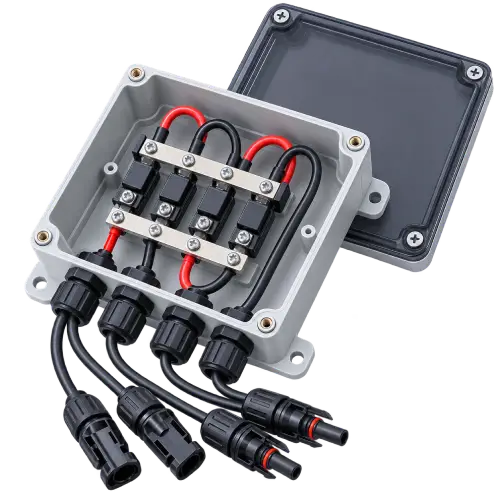
A Solar Junction Box is an important component of a photovoltaic system, providing a protected point for electrical connections between solar modules, cables and other DC-side components. Depending on the application, it can incorporate bypass diodes, cable terminals, connectors and protective elements.
Sohum Industrial Sales Corporation supply Solar Junction Boxes for rooftop solar systems, industrial PV installations, commercial projects, solar farms and module-level applications in West Bengal, Kolkata, Odisha, Chhattisgarh, Bihar, Arunachal Pradesh, Assam, Manipur, Meghalaya, Mizoram, Nagaland, and Tripura. Our product options can be selected according to the system voltage, current, cable size, number of inputs, enclosure requirement and installation environment.
- Structural Advantages
A well-designed Solar Junction Box combines electrical functionality with protection against the conditions commonly found in solar installations.
- UV-Resistant Housing
The enclosure can be manufactured from suitable weather-resistant insulating materials designed for prolonged outdoor exposure.
- Sealed Cable Entry
Proper sealing around cable entries helps limit the entry of moisture, dust and other contaminants.
- Compact Construction
Module-level junction boxes are designed to occupy limited space on the rear of a solar panel while maintaining adequate electrical clearance.
- Secure Internal Connections
Suitable terminals and contact components help maintain reliable electrical continuity when correctly assembled.
- Bypass Diode Integration
Module junction boxes can incorporate bypass diodes to provide an alternative current path around affected portions of a PV module under certain operating conditions.
- Protection-Oriented Design
For array-level applications, the junction box can be configured with components such as fuses, SPDs and isolators according to the electrical design.
Key Reasons to Choose This Product
- Designed for Photovoltaic Applications
Unlike ordinary electrical enclosures, Solar Junction Boxes are specifically developed around the requirements of PV installations.
- Suitable for Outdoor Conditions
Solar installations are exposed to sunlight, rain, humidity, dust and temperature variations. Appropriate enclosure materials and sealing help the junction box withstand these conditions.
- Supports Organized DC Connections
The box provides a structured arrangement for cable termination and connection, helping keep the DC wiring system organized.
- Flexible Configuration
Different projects may require different input counts, voltage ratings, protection devices and cable-entry arrangements. Configurations can therefore be selected according to the application.
- Easy Integration
Solar Junction Boxes can be incorporated into module, string or array-level electrical arrangements depending on their design.
- Product Dimensions & Ratings
Solar Junction Boxes are available in different dimensions because a compact module box and a multi-string array box have completely different requirements.
Module-Level Junction Box
Parameter | Typical Options |
Product Type | PV Module Junction Box |
Approx. Length | 80–150 mm class |
Approx. Width | 50–100 mm class |
Height | Application-dependent |
Voltage | 1000 V DC / 1500 V DC options |
Current | Approximately 10–30 A+, model-dependent |
Protection | IP65 / IP67 / IP68 options |
Diodes | Bypass diode options |
Cable | PV cable compatible |
Installation | Rear side of PV module |
String / Array Junction Box
Parameter | Typical Options |
DC Voltage | 600 V / 1000 V / 1500 V DC |
Inputs | 1 / 2 / 4 / 8 / 12 / 16 / 24+ |
Outputs | Single or multiple |
Fuse | gPV DC fuse options |
SPD | Type 2 / specified DC SPD options |
Isolator | DC isolator option |
Enclosure | Polycarbonate / GRP / FRP / Metal |
Protection | IP65 / IP66 / IP67 |
Mounting | Wall / structure mounted |
Cable Entry | Gland / PV connector |
Exact dimensions, voltage, current, IP rating and internal configuration depend on the selected model and project specification.
Important Technical Parameters
When purchasing a Solar Junction Box, consider:
- Maximum DC Voltage
The box should be rated for the maximum voltage of the PV system. - Operating Current
Internal contacts, terminals and protection components must be appropriately rated for the expected current. - Number of Strings
The input quantity determines the internal arrangement and enclosure size of an array-level box. - Cable Size
Cable glands, terminals and connectors must accommodate the specified solar cable. - IP Protection
Outdoor PV installations require an appropriate ingress-protection level. - Temperature Rating
The product should be suitable for the temperature range expected at the installation site. - Protection Devices
Fuses, SPDs and isolators should be included where required by the system design.
Applications Across Industries
- Residential Solar
Used in rooftop PV systems to organize and protect selected module and DC connections.
- Commercial Buildings
Suitable for solar installations on offices, shopping centres, hotels and institutional buildings.
- Industrial Rooftops
Can be incorporated into captive solar systems installed on factories and industrial buildings.
- Solar Power Plants
String and array-level junction boxes can be used to manage multiple PV circuits across large solar installations.
- Solar Manufacturing
Module-level junction boxes form part of the electrical assembly of photovoltaic panels.
- Solar Water Pumping
Suitable configurations can be used in PV-powered pumping systems.
- Infrastructure Projects
Useful for solar installations supporting remote facilities, infrastructure and utility applications.
- Floating Solar
Junction boxes designed with appropriate environmental protection can be considered for floating PV applications.
Manufactured for Reliability
The operating environment of a solar installation can be demanding. A Junction Box may remain exposed to UV radiation, heat, rain, humidity, dust and repeated temperature changes throughout its service life.
For this reason, attention should be given to:
- Enclosure material
- UV resistance
- Sealing quality
- Electrical clearance
- Contact quality
- Cable entry arrangement
- Thermal performance
- Protection rating
- Mechanical strength
- Applicable testing and certification
For PV module junction boxes, IEC 62790 provides requirements concerning construction, safety and testing. For the actual product, customers should verify the manufacturer’s current datasheet and certification for the specific model.
Why Customers Trust Us
We understand that solar projects can involve hundreds or thousands of electrical connection points. A suitable Junction Box therefore needs to be selected according to the actual PV system rather than simply by appearance or enclosure size.
Our Supply Advantages
- Specification-Based Selection
We focus on voltage, current, cable size, input count and protection requirements. - Different Configurations
Customers can enquire about module-level, string-level and array-level solutions. - Project Quantity Support
Suitable for rooftop installers as well as larger EPC and solar-farm requirements. - Custom Requirement Assistance
Where standard configurations do not meet the project requirement, dimensions and internal arrangements can be discussed. - Competitive Project Pricing
Pricing can be optimized according to configuration, quantity and technical specification. - Solar-Focused Procurement
Our approach helps customers source junction boxes according to PV-specific requirements rather than using generic electrical boxes.
Why This Product Is the Right Choice
A Solar Junction Box is a relatively small component, but its role in organizing and protecting PV electrical connections is significant.
- It Helps Keep Connections Organized
Instead of leaving multiple cable connections exposed or poorly arranged, the junction box provides a defined connection point.
- It Supports Outdoor PV Installations
With appropriate enclosure and sealing specifications, it can withstand the environmental conditions associated with solar projects.
- It Can Incorporate Protection
Depending on the type, the box can accommodate bypass diodes, fuses, surge protection and isolation components.
- It Supports Different Solar Architectures
From a single PV module to a large solar array, different junction-box configurations are available.
- It Simplifies Maintenance
A properly designed and labelled connection arrangement can make inspection and maintenance more manageable.
Solar Junction Box Selection Guide
Before placing an order, provide:
Requirement | Information Needed |
Solar Application | Module / String / Array |
System Voltage | 600 V / 1000 V / 1500 V DC etc. |
Current | Required operating/current rating |
Input Count | Number of PV strings |
Output Count | Required outputs |
Cable Size | 2.5 / 4 / 6 sq. mm or as required |
Protection | Fuse / SPD / Isolator |
Enclosure | Plastic / GRP / FRP / Metal |
IP Rating | Project requirement |
Quantity | Number of boxes |
Installation | Rooftop / Ground / Industrial / Other |
Get Solar Junction Boxes for Your Project
Whether you need PV Module Junction Boxes, String Junction Boxes or Array Junction Boxes, choosing the correct electrical rating and environmental protection is essential.
We supply Solar Junction Box solutions for projects across:
West Bengal | Kolkata | Odisha | Chhattisgarh | Bihar | Arunachal Pradesh | Assam | Manipur | Meghalaya | Mizoram | Nagaland | Tripura
Build Better Solar Connections
Choose a Solar Junction Box based on system voltage, current capacity, protection requirements, enclosure quality, cable compatibility and project conditions. For quotations, share your required dimensions, voltage, current, input count, cable size and quantity to identify the appropriate Solar Junction Box configuration.


