

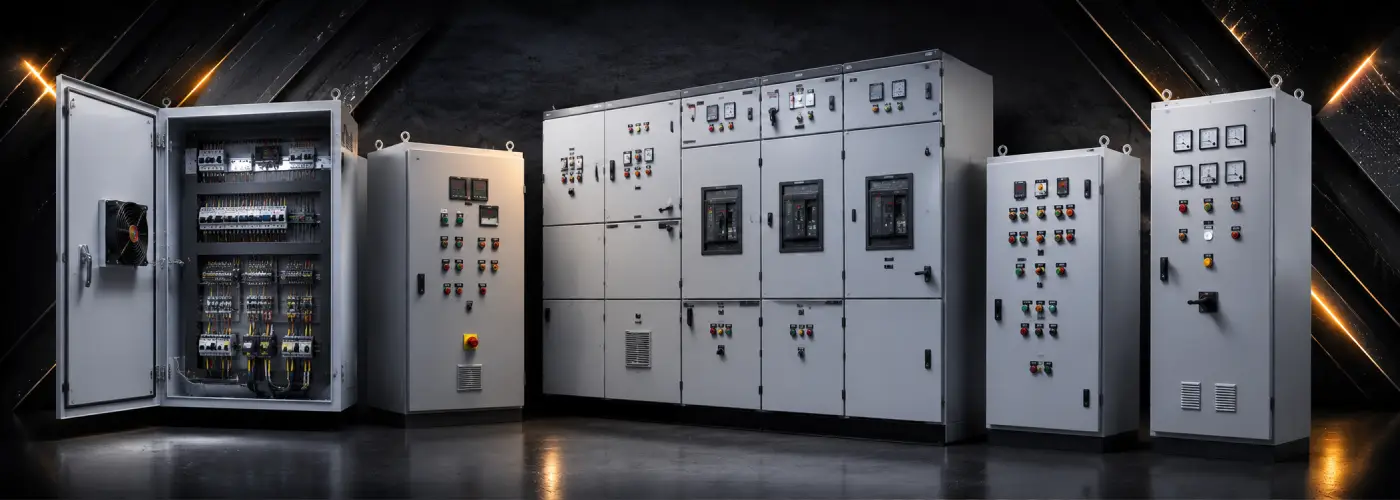
PLC Panels Supplier
Sohum Industrial Sales Corporation supplies PLC Panels for machine automation, production control, process monitoring and industrial electrical applications across West Bengal, Kolkata, Odisha, Chhattisgarh, Bihar, Arunachal Pradesh, Assam, Manipur, Meghalaya, Mizoram, Nagaland, Tripura and Bhutan.
A Control Panel Built Around Programmable Logic
A PLC Panel is an electrical control enclosure in which a Programmable Logic Controller (PLC) works as the central decision-making unit of an automated system. It receives information from field devices, processes the programmed logic and sends commands to connected equipment.
For example, sensors may detect the position, temperature, pressure or movement of a process. The PLC evaluates those signals and can then operate motors, valves, contactors, drives, alarms or other equipment according to the programmed sequence. This makes PLC Panels particularly useful where machines or processes need repeatable control, sequencing, interlocking and real-time monitoring.
What Can a PLC Panel Actually Do?
The capabilities of a PLC Panel depend on the PLC architecture and application programming. A system can be developed to perform functions such as:
- Starting and stopping machinery
- Automatic sequence control
- Motor interlocking
- Sensor-based operation
- Level monitoring
- Temperature-based control
- Pressure monitoring
- Alarm generation
- Fault indication
- Automatic changeover logic
- Equipment status monitoring
- Data communication with other systems
- Manual and automatic operating modes
The PLC itself is only one part of the solution. Proper selection of field instruments, I/O modules, drives, protection devices and communication hardware is equally important.
Inside a Typical PLC Panel
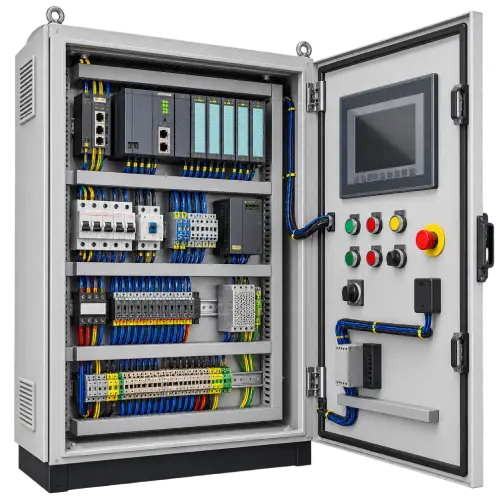
A PLC Panel may contain a combination of the following equipment:
- PLC CPU
The CPU executes the programmed control logic and coordinates the connected inputs and outputs.
- I/O Modules
Digital and analogue I/O modules allow the PLC to communicate with sensors, switches, transmitters, motors and actuators.
- 24V DC Power Supply
A DC power supply can provide control power for PLC electronics, sensors, relays and other low-voltage control circuits.
- HMI
An optional Human Machine Interface allows operators to view process information, alarms, parameters and machine status.
- Interposing Relays
Relays can be used to interface PLC outputs with external loads and control circuits where required.
- Communication Hardware
Industrial Ethernet, serial communication or other suitable interfaces can connect the PLC to HMIs, drives, SCADA systems or other controllers.
- Circuit Protection
MCBs, fuses, MCCBs and other suitable protective devices can be incorporated according to the circuit requirements.
PLC Panel Technical Reference
The specifications below represent common configuration possibilities. The final design should be determined from the machine or process requirements.
|
Parameter |
Typical Configuration |
|
Controller |
PLC / Programmable Automation Controller |
|
Incoming Supply |
230V / 415V AC |
|
Control Supply |
24V DC commonly used |
|
PLC I/O |
Digital & Analogue, application dependent |
|
HMI |
Optional |
|
Motor Interface |
Contactor / VFD / Soft Starter / Servo Drive |
|
Communication |
Ethernet / Modbus / Other compatible protocol |
|
Protection |
MCB / MCCB / Fuse |
|
Control Relays |
Application dependent |
|
Panel Enclosure |
Fabricated Sheet Steel |
|
Mounting |
Wall Mounted / Floor Standing |
|
Cooling |
Natural / Fan / Air Conditioner, based on heat dissipation |
|
Cable Entry |
Top / Bottom / Side |
|
Operating Mode |
Manual / Automatic |
|
Indication |
LED / HMI / Annunciator |
|
Expansion |
Spare I/O can be provided where required |
Actual PLC make, I/O capacity, communication protocol, drive ratings, enclosure dimensions and protection arrangement depend on the project.
PLC Panel vs Automation Panel — Are They the Same?
The two terms are closely related but are not always interchangeable. An Automation Panel is a broader category that can contain PLCs, drives, relays, HMIs, controllers and other automation equipment. A PLC Panel specifically centres the control architecture around a PLC. It may therefore be considered a specialised type of automation panel. For SEO and technical purposes, describing the panel according to its actual control architecture is preferable to using the terms interchangeably.
How Signals Travel Through the System
A PLC-based control arrangement can be understood through a simple sequence:
Field Sensor → Input Module → PLC CPU → Programmed Logic → Output Module → Relay/Drive/Contactor → Machine or Process
For analogue applications, the PLC may receive signals from transmitters representing parameters such as temperature, pressure, flow or level.
The controller can then compare those values against programmed conditions and initiate the required output.
Where PLC Panels Are Used
PLC-based control can be adapted to numerous industries and machines.
- Manufacturing Plants
Used for production machinery, automated lines and equipment sequencing.
- Water Treatment Systems
Suitable for controlling pumps, valves, tank levels and treatment processes.
- Material Handling
Can coordinate conveyors, sensors, motors and automated transfer systems.
- Packaging Machinery
Useful for synchronising sensors, motors, actuators and packaging sequences.
- Process Industries
PLC systems can monitor and control multiple process parameters through suitable field instrumentation.
- Pumping Applications
Suitable for automatic pump sequencing, level-based operation and duty/standby arrangements.
- HVAC & Building Services
Can be incorporated into systems requiring automatic equipment operation and monitoring.
- Industrial Machinery
Suitable for machines requiring repeatable sequences, safety interlocks and operator controls.
What Should Be Specified Before Ordering a PLC Panel?
A clear technical requirement helps avoid unnecessary changes after panel fabrication. Important information includes:
- Number of digital inputs
- Number of digital outputs
- Number of analogue inputs
- Number of analogue outputs
- Sensor and transmitter types
- Motor quantity and ratings
- VFD or soft-starter requirements
- HMI requirement
- Communication protocol
- Control voltage
- Incoming power supply
- Required operating sequence
- Number of machines/process sections
- Indoor or outdoor installation
- Future expansion requirements
Providing an I/O list and control philosophy can be particularly helpful when the panel is intended for a complex industrial process.
Construction & Wiring Approach
PLC Panels require careful internal organisation because control wiring, power wiring and communication cables may coexist within the same enclosure.
Depending on the application, the construction can include:
- Dedicated PLC mounting area
- DIN-rail mounted components
- Numbered terminal blocks
- Slotted wiring ducts
- Segregated power and control wiring
- Proper earthing arrangement
- Cable identification
- Shield termination provisions for suitable signal cables
- Removable gland plates
- Cooling provisions
- Spare terminals and I/O provisions
Good internal organisation can make troubleshooting and future modifications considerably easier.
Why Sohum Industrial Sales Corporation for PLC Panels?
Sohum Industrial Sales Corporation supplies PLC Panels for customers looking for structured programmable control solutions across West Bengal, Kolkata, Odisha, Chhattisgarh, Bihar, Arunachal Pradesh, Assam, Manipur, Meghalaya, Mizoram, Nagaland, Tripura and Bhutan.
The company can cater to requirements involving PLC control, HMI integration, motor control, VFD interfaces, industrial communication, process monitoring and machine automation.
Instead of relying on a single standard configuration, PLC Panels can be selected around the actual I/O requirements, equipment connected to the system and intended operating sequence.
A Flexible Foundation for Industrial Automation
The major advantage of PLC-based control is its flexibility. When the process changes, control logic can often be modified through programming without completely redesigning the electrical architecture. A properly planned PLC Panel can therefore provide a central platform for machine sequencing, process monitoring, equipment coordination and automated decision-making. For industries seeking a dependable programmable control arrangement, Sohum Industrial Sales Corporation supplies PLC Panels throughout eastern and northeastern India, with configurations suited to different industrial and commercial applications.


