

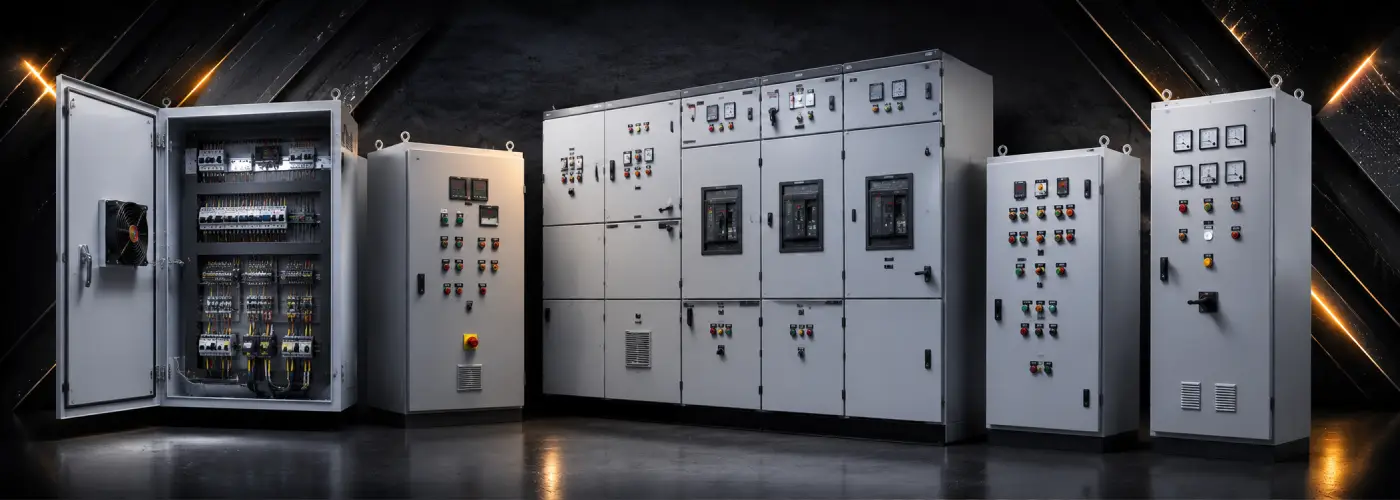
Control & Relay Panels Supplier
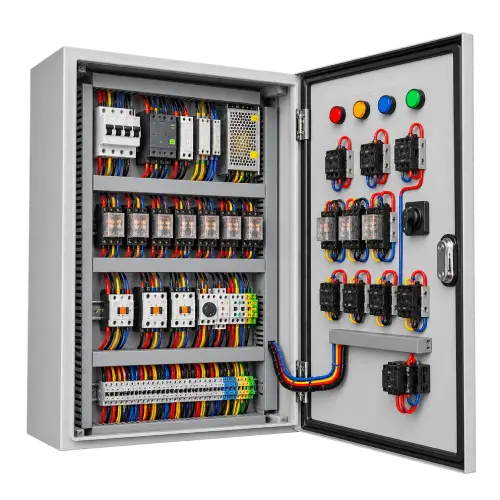
Sohum Industrial Sales Corporation supplies Control & Relay Panels for electrical protection, equipment control, monitoring and switching applications. With solutions suitable for industrial plants, substations, power systems and infrastructure projects, the company serves customers across West Bengal, Kolkata, Odisha, Chhattisgarh, Bihar, Arunachal Pradesh, Assam, Manipur, Meghalaya, Mizoram, Nagaland, Tripura and Bhutan.
What Are Control & Relay Panels?
- Control & Relay Panels are specialised electrical assemblies used to bring together control devices, protective relays, indication equipment, metering instruments and associated wiring in one organised enclosure.
- A Control Panel primarily manages the operation of electrical equipment through switches, contactors, relays, timers, meters and control circuits.
- A Relay Panel focuses more on protection and monitoring. Protective relays continuously evaluate electrical conditions and can initiate a trip command when an abnormal condition is detected.
- In practical applications, the two functions can work together:
- Electrical Parameters → CT/PT Signals → Protection Relay → Trip Logic → Circuit Breaker
- This arrangement allows the panel to become an important interface between the electrical system and its protection/control equipment.
Control Panels Supplier for Industrial Electrical Systems
As a Control Panels Supplier, Sohum Industrial Sales Corporation provides panel configurations for applications where equipment needs organised local control, status indication and electrical interlocking.
Depending on the requirement, control panels may incorporate:
- Selector switches
- Push buttons
- Contactors
- Auxiliary relays
- Timers
- Control transformers
- SMPS
- Indication lamps
- Digital meters
- Terminal blocks
- Annunciators
- Emergency-stop circuits
- Interlocking arrangements
The internal configuration is selected according to the equipment being controlled and the required operating sequence.
Relay Panels Supplier for Protection & Monitoring
As a Relay Panels Supplier, Sohum Industrial Sales Corporation caters to applications where electrical parameters need to be monitored and abnormal conditions need to be identified.
Protective relays can be selected according to the system and may provide functions such as:
- Overcurrent protection
- Earth-fault protection
- Under-voltage protection
- Over-voltage protection
- Frequency protection
- Motor protection
- Transformer protection
- Feeder protection
- Trip circuit supervision
- Breaker status monitoring
Not every relay panel requires all these functions. The protection philosophy should be established according to the electrical system and coordination study.
How a Relay Panel Responds to an Electrical Fault
A protection system generally follows a sequence rather than simply switching a breaker manually.
- Electrical Condition Changes
A fault or abnormal operating condition occurs within the protected circuit.
- Instrument Transformers Detect the Condition
CTs and/or VTs provide suitable measurement signals to the protection system.
- Relay Evaluates the Signal
The protection relay compares the measured condition against its configured settings.
- Trip Command Is Initiated
If the condition satisfies the protection criteria, the relay sends a trip command.
- Circuit Breaker Operates
The associated breaker disconnects the affected section according to the protection scheme.
This coordinated process helps limit the impact of electrical faults and protect connected equipment.
Technical Specification Chart
The following values represent typical configuration options. Actual specifications depend on the application, voltage level, protection scheme and selected components.
|
Parameter |
Typical Configuration |
|
Product |
Control & Relay Panel |
|
Application |
Control / Protection / Monitoring |
|
System |
LT / HT, application dependent |
|
Control Supply |
24V DC / 48V DC / 110V DC / 220V DC or AC, as required |
|
Protection Relays |
Numerical / Electromechanical, application dependent |
|
Measurement Inputs |
CT / VT |
|
Metering |
V, A, Hz, kW, kVA, PF, Energy, as required |
|
Control Devices |
Push Buttons / Selector Switches / Relays |
|
Indication |
LED / Annunciator / HMI |
|
Communication |
Ethernet / RS-485 / Other compatible protocol |
|
Enclosure |
Fabricated Sheet Steel |
|
Mounting |
Wall Mounted / Floor Standing |
|
Cable Entry |
Top / Bottom |
|
Wiring |
Ferruled and Identified Control Wiring |
|
Earthing |
Dedicated Earth Connection |
|
Installation |
Indoor / Outdoor, according to design |
|
Protection |
Application-specific electrical protection |
These are indicative parameters and should not be considered a fixed specification for every Control & Relay Panel.
The Difference Between a Control Panel and a Relay Panel
Although both panels can contain relays and control components, their primary functions are different.
|
Feature |
Control Panel |
Relay Panel |
|
Main Purpose |
Equipment operation and control |
Protection and fault detection |
|
Typical Equipment |
Contactors, switches, timers, PLCs, relays |
Protection relays, CT/VT circuits, trip logic |
|
Main Function |
Start, stop, sequence and interlock |
Detect abnormal electrical conditions |
|
Typical Use |
Machines, pumps, motors, process equipment |
Feeders, transformers, substations |
|
Output |
Control command |
Protection/trip command |
In some installations, these functions can be incorporated into one integrated panel.
Construction Designed for Clear Identification
Control and relay panels often contain a significant amount of control wiring. Proper internal arrangement therefore becomes important for maintenance and troubleshooting.
Depending on the design, the panel can include:
- Robust sheet-steel enclosure
- Separate control and power sections where required
- DIN-rail mounting
- Terminal blocks
- Numbered wires and ferrules
- Cable ducts
- Clearly labelled components
- Dedicated earthing points
- Removable gland plates
- Test terminals for relay circuits
- Space for future modifications
A well-organised wiring layout can make it easier for technicians to trace signals and identify individual circuits.
Where Control & Relay Panels Are Used
These panels can be adapted to a variety of electrical installations.
- Electrical Substations
Used for feeder protection, breaker control, indication and monitoring.
- Transformer Installations
Can interface transformer protection signals with circuit-breaker trip circuits and annunciation systems.
- Industrial Plants
Suitable for controlling motors, pumps, compressors and other electrical equipment.
- Power Distribution Systems
Can provide feeder monitoring and protection functions.
- Generating Stations
Suitable for control, protection and electrical parameter monitoring associated with generation systems.
- Water Treatment Plants
Used for equipment control, pump operation and electrical monitoring.
- Infrastructure Projects
Can be incorporated into electrical systems requiring centralised protection and control.
Features That Can Be Added According to the Project
A Control & Relay Panel does not need to follow one standard arrangement. Depending on the application, additional functionality can be incorporated.
Possible options include:
- Local/remote selection
- Breaker open/close control
- Trip circuit supervision
- Annunciation
- Event recording
- Digital metering
- Communication with SCADA
- Remote monitoring
- Auto/manual selection
- Interlocking
- Equipment status indication
- Spare terminals for future expansion
This modular approach allows the panel to be adapted to relatively simple control requirements as well as more sophisticated protection systems.
Important Information Required Before Panel Selection
For accurate panel configuration, customers should ideally provide:
- System voltage
- Single-line diagram
- Connected load
- Number of breakers
- CT/PT details
- Protection functions required
- Relay make/model, if specified
- Control voltage
- Number of digital/analogue signals
- Metering requirements
- Communication requirements
- Indoor/outdoor installation
- Cable-entry arrangement
- Enclosure dimensions or space limitations
These details help ensure that the panel is designed around the actual electrical system rather than a generic component list.
Quality & Testing Considerations
Control and relay panels should undergo appropriate inspection and testing before being placed into service.
Depending on the panel type and project specification, checks can include:
- Wiring continuity
- Terminal identification
- Insulation checks
- Protective-circuit continuity
- Functional operation
- Relay operation
- Trip circuit verification
- Breaker control checks
- Metering verification
- Indication checks
- Interlocking verification
- Communication testing
For low-voltage assemblies within the applicable scope, IEC 61439 provides requirements and verification principles for switchgear and controlgear assemblies. The specific standard requirements depend on the type of assembly.
Why Choose Sohum Industrial Sales Corporation?
Sohum Industrial Sales Corporation supplies Control & Relay Panels for customers requiring electrical control, protection and monitoring solutions across West Bengal, Kolkata, Odisha, Chhattisgarh, Bihar, Arunachal Pradesh, Assam, Manipur, Meghalaya, Mizoram, Nagaland, Tripura and Bhutan.
The company caters to requirements ranging from straightforward equipment-control panels to protection-oriented relay assemblies for industrial and electrical distribution applications.
Customers can specify requirements based on the control philosophy, protection functions, system voltage, number of circuits, relay configuration, metering requirements and communication needs.
A Panel That Connects Protection with Action
Control & Relay Panels play a crucial role where electrical systems need both decision-making and controlled response. A relay can identify an abnormal condition, while the associated control circuitry can determine how the system should respond.
When properly configured, these panels provide a central point for protection, switching, indication, measurement and control, helping operators and maintenance teams manage electrical equipment more systematically.
For reliable Control Panels Supplier and Relay Panels Supplier requirements, Sohum Industrial Sales Corporation provides application-focused solutions across eastern and northeastern India.


