

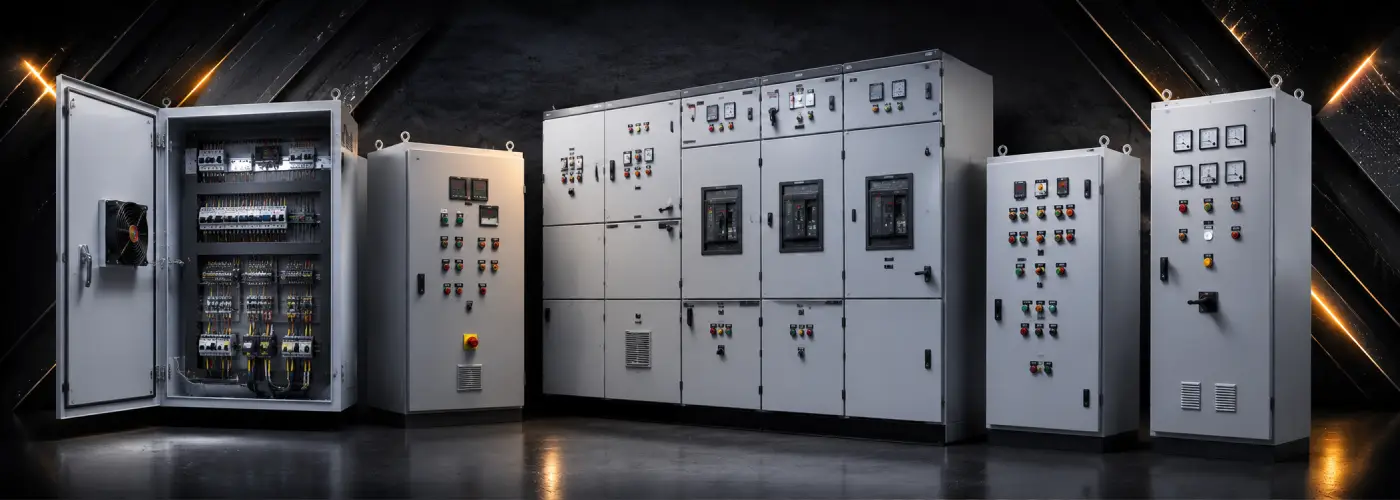
HT Panels Supplier
Sohum Industrial Sales Corporation supplies HT Panels for electrical distribution, switching and protection requirements in industrial plants, substations, commercial infrastructure and utility installations across West Bengal, Kolkata, Odisha, Chhattisgarh, Bihar, Arunachal Pradesh, Assam, Manipur, Meghalaya, Mizoram, Nagaland, Tripura, Bhutan.
HT switchgear is selected according to the system voltage, short-circuit level, protection philosophy, transformer capacity, incoming supply arrangement and site conditions. Rather than treating an HT panel as a standard enclosure, its configuration should be matched to the complete electrical network.
Product Introduction
HT Panels are high-voltage electrical switchgear assemblies used to control, isolate, protect and distribute electrical power. They provide a controlled point for connecting incoming supplies with transformers, feeders, motors or other high-voltage equipment.
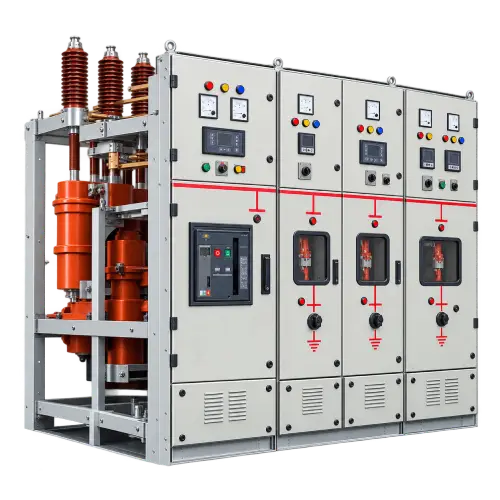
Depending on the system design, an HT panel may incorporate VCBs, protection relays, current transformers, voltage transformers, busbars, isolators, earthing switches, metering equipment and interlocking mechanisms. These assemblies are commonly found in substations and large electrical installations where reliable switching and fault protection are essential.
A Protection-Centred Approach to HT Power Distribution
The primary purpose of HT switchgear is not simply to carry electrical power. It must also respond appropriately when abnormal conditions occur.
A properly coordinated HT panel can help:
- Interrupt fault currents through the appropriate breaker
- Isolate faulty sections
- Protect transformers and downstream equipment
- Provide controlled switching
- Monitor important electrical parameters
- Support safe maintenance isolation
- Coordinate with upstream and downstream protection systems
The exact protection philosophy depends on the electrical network and should be established through appropriate engineering studies.
Core Components Inside an HT Panel
The internal equipment varies according to the application, but an HT panel can include several specialised components.
- Vacuum Circuit Breaker (VCB)
VCBs are widely used in medium-voltage switchgear for switching and interrupting electrical circuits under normal and fault conditions.
- Protection Relays
Relays detect abnormal electrical conditions and initiate breaker operation according to the programmed protection scheme.
- Current Transformers
CTs provide scaled current signals for protection, metering and monitoring equipment.
- Voltage Transformers
VTs/PTs provide suitable voltage signals for metering and protection functions.
- Busbar System
Busbars provide the electrical connection between incoming and outgoing circuits within the switchgear assembly.
- Earthing & Interlocking Arrangement
Mechanical and electrical interlocking can be incorporated to help prevent unsafe operating sequences and support controlled isolation procedures.
Typical Technical Configuration
|
Parameter |
Typical / Project-Dependent Selection |
|
Panel Type |
Indoor / Outdoor HT Switchgear |
|
Common Technology |
VCB-based switchgear |
|
System Frequency |
50 Hz |
|
Rated Voltage |
3.3 kV / 6.6 kV / 11 kV / 22 kV / 33 kV, as applicable |
|
Rated Current |
Selected according to load and feeder requirement |
|
Short-Circuit Rating |
Selected according to system fault level |
|
Breaker |
Vacuum Circuit Breaker |
|
Protection |
Overcurrent / Earth Fault / other application-specific schemes |
|
Instrument Transformers |
CT / VT / PT |
|
Busbar |
Copper / Aluminium, according to design |
|
Metering |
Digital multifunction / dedicated meters |
|
Earthing |
Dedicated earthing arrangement |
|
Cable Entry |
Top / Bottom, as required |
|
Installation |
Indoor / Outdoor |
|
Interlocking |
Mechanical / Electrical, according to configuration |
Why the Fault Level Matters
- One of the most important considerations in HT switchgear selection is the prospective short-circuit current at the installation point.
- The panel and its switching devices must be capable of performing their specified duty under the relevant fault conditions. Selecting equipment solely according to normal load current is therefore insufficient.
- Fault level, breaker interrupting capability, short-time withstand current, peak withstand current and protection coordination should be considered during engineering and selection.
Construction Designed Around Electrical Segregation
- HT panels can be fabricated with dedicated sections for the circuit breaker, busbar, cable termination, control wiring and low-voltage protection equipment.
- Depending on the design, compartments may be arranged to limit access to energised sections and simplify maintenance. Robust enclosure construction, suitable insulation clearances, reliable earthing and secure cable termination are important aspects of the overall assembly.
- For outdoor installations, environmental conditions such as dust, moisture, temperature and exposure should also be considered while selecting the enclosure and insulation arrangement.
Protection & Control Features
An HT panel can be configured with protection and monitoring functions such as:
- Overcurrent protection
- Earth-fault protection
- Under-voltage protection
- Over-voltage protection
- Transformer protection interfaces
- Trip circuit supervision
- Breaker status indication
- Local/remote operation
- Electrical energy metering
- Annunciation
- Interlocking
- Communication interfaces, where required
The final relay functions should be determined by the system protection study rather than adding unnecessary functions to every panel.
Where HT Panels Find Their Place
HT switchgear is commonly used in:
- Industrial substations
- Manufacturing plants
- Steel and metal facilities
- Cement plants
- Power distribution networks
- Large commercial complexes
- Infrastructure projects
- Water treatment installations
- Mining and processing facilities
- Transformer substations
- Large pumping stations
- Renewable-energy electrical systems
HT Panel Selection: What Should Be Checked First?
Before placing an order, the following project information should normally be established:
- System voltage and frequency
- Incoming source and transformer details
- Maximum operating load
- Number of incoming and outgoing feeders
- Prospective short-circuit current
- CT/PT requirements
- Protection relay functions
- Cable size and termination arrangement
- Indoor or outdoor installation
- Required communication and remote-control facilities
This information helps ensure that the selected HT panel is compatible with the actual electrical network.
Why Sohum Industrial Sales Corporation?
Sohum Industrial Sales Corporation supplies HT Panels for industrial, commercial, infrastructure and power-distribution requirements. The company serves customers across West Bengal, Kolkata, Odisha, Chhattisgarh, Bihar, Arunachal Pradesh, Assam, Manipur, Meghalaya, Mizoram, Nagaland, Tripura, Bhutan.
The company can cater to requirements involving HT distribution, transformer feeders, industrial substations and other medium-voltage electrical applications, with panel configurations selected according to project-specific electrical requirements.
A Reliable Interface Between the Grid and Critical Equipment
HT Panels form an important part of electrical distribution infrastructure because they combine switching, isolation, protection, metering and control within a structured switchgear arrangement.
For facilities where electrical continuity, fault management and controlled power distribution are critical, selecting HT equipment according to the actual system voltage, fault level and protection philosophy is essential.
With its range of electrical-panel solutions, Sohum Industrial Sales Corporation provides HT Panel supply support for customers across eastern and northeastern India.


