

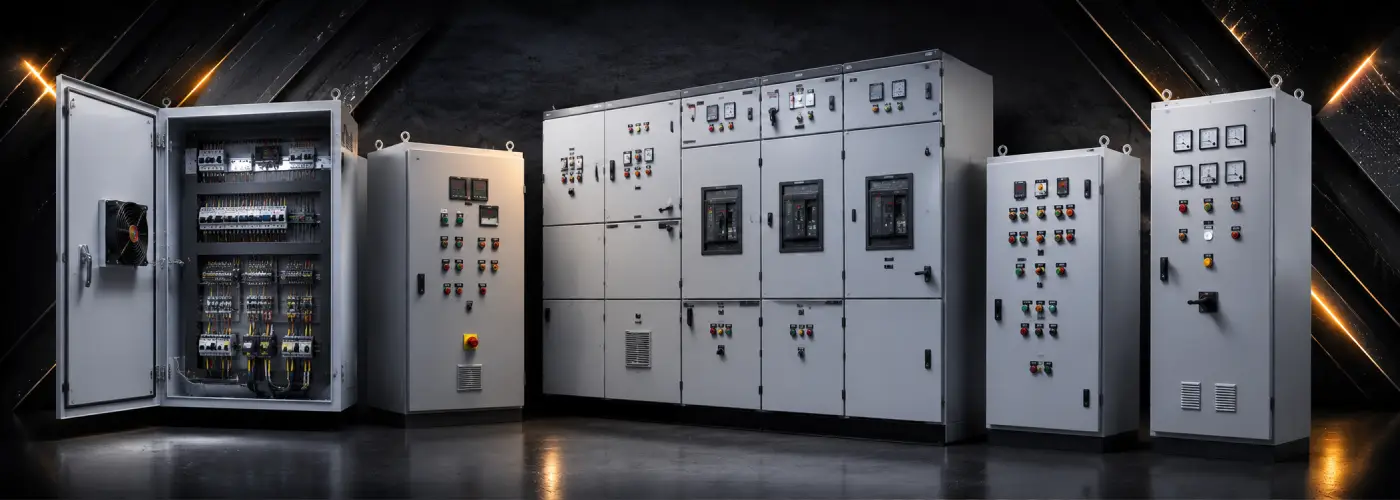
MCCB Distribution Panels Supplier
Sohum Industrial Sales Corporation supplies MCCB Distribution Panels for industrial plants, commercial buildings, infrastructure projects, workshops, utility systems and other electrical installations across West Bengal, Kolkata, Odisha, Chhattisgarh, Bihar, Arunachal Pradesh, Assam, Manipur, Meghalaya, Mizoram, Nagaland, Tripura and Bhutan.
MCCB Distribution Panels are used when electrical loads require a stronger and more adjustable protection arrangement than a basic MCB distribution board can provide. They bring multiple higher-capacity feeders into a structured panel while providing switching, protection and distribution from a common assembly.
What Exactly Is an MCCB Distribution Panel?
An MCCB Distribution Panel is an electrical distribution assembly that uses Moulded Case Circuit Breakers (MCCBs) to control and protect incoming and/or outgoing power circuits.
The MCCB acts as a switching and protective device. Depending on its design and trip unit, it can provide protection against conditions such as overload and short circuit, with additional functions available in suitable electronic trip units.
A typical arrangement can be represented as:
Incoming Supply → Main MCCB → Busbar → Individual MCCBs → Connected Loads
The exact arrangement depends on the number, rating and nature of the circuits being supplied.
When Does an MCCB-Based Panel Make Sense?
MCCB panels are particularly useful when the installation contains several medium- or higher-current feeders.
They can be considered for:
- Large motor feeders
- Industrial machinery
- HVAC systems
- Pumps
- Compressors
- Manufacturing equipment
- Large commercial electrical loads
- Generator distribution
- Transformer secondary distribution
- Industrial utility services
The correct MCCB rating should be selected according to the actual load current, cable capacity and prospective fault conditions.
A Closer Look at the MCCB
The performance of an MCCB depends on its frame size, rated current, breaking capacity and trip characteristics.
Depending on the model, MCCBs can offer:
- Thermal-magnetic protection
- Electronic trip protection
- Adjustable overload settings
- Adjustable short-circuit settings
- Instantaneous protection
- Auxiliary contacts
- Alarm contacts
- Under-voltage accessories
- Shunt-trip arrangements
- Motorised operating mechanisms
Not every MCCB provides all these features, so the breaker specification should be matched to the electrical design.
Technical Specification Chart
The following table provides typical configuration options for MCCB Distribution Panels. Actual values vary according to the selected panel and MCCB model.
|
Parameter |
Typical Specification / Option |
|
Panel Type |
MCCB Distribution Panel |
|
System |
3 Phase, 4 Wire / application dependent |
|
Common Operating Voltage |
415 V AC |
|
Frequency |
50 Hz |
|
Main Incomer |
MCCB / ACB, according to requirement |
|
Outgoing Protection |
MCCB |
|
MCCB Current Range |
Approx. 63A – 1600A+, model dependent |
|
Breaking Capacity |
Selected according to system fault level |
|
Busbar Material |
Copper / Aluminium |
|
Busbar Rating |
Based on maximum connected load |
|
Trip Unit |
Thermal-Magnetic / Electronic |
|
Metering |
Ammeter / Voltmeter / Multifunction Meter |
|
Surge Protection |
Optional, application dependent |
|
Enclosure |
Fabricated Sheet Steel |
|
Mounting |
Floor Standing / Wall Mounted |
|
Cable Entry |
Top / Bottom |
|
Installation |
Indoor / Outdoor |
|
Control Supply |
As required by accessories |
|
Enclosure Protection |
Selected according to environment |
Why MCCBs Are Used Instead of Only MCBs
MCBs are commonly used for smaller final circuits, while MCCBs are available in larger current ratings and configurations suitable for higher-capacity feeders.
An MCCB may therefore be preferred where the electrical installation requires:
Higher current capacity + greater breaking capability + adjustable protection + additional accessories
For industrial installations, the ability to select appropriate trip characteristics can be particularly useful for coordinating protection between the main incomer and downstream feeders.
How the Panel Distributes Electrical Power
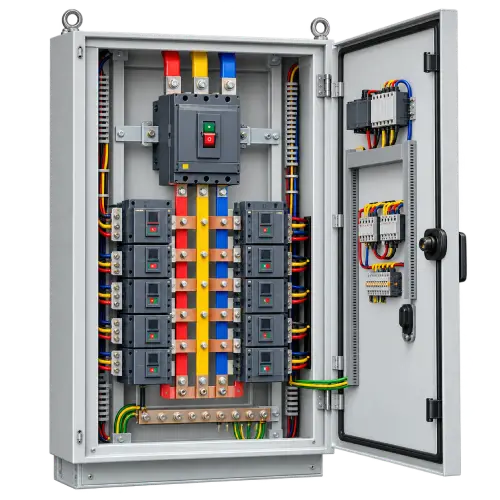
Inside the panel, the incoming MCCB feeds the main busbar system. Individual outgoing MCCBs then take power from the busbar and supply separate circuits.
For example:
Main Incomer
↓
Copper/Aluminium Busbar
↓
MCCB Feeder 1 → Motor
MCCB Feeder 2 → Pump
MCCB Feeder 3 → HVAC
MCCB Feeder 4 → Distribution Board
MCCB Feeder 5 → Machinery
This arrangement allows individual feeders to be switched or isolated without necessarily disconnecting the entire distribution system.
Panel Construction & Internal Arrangement
MCCB Distribution Panels can be fabricated around the required breaker arrangement and cable termination requirements.
Typical construction may include:
- Sheet-steel enclosure
- Separate incoming and outgoing sections
- Copper/aluminium busbars
- Insulated busbar supports
- MCCB mounting plates
- Cable chambers
- Removable gland plates
- Neutral and earth bars
- Internal control wiring
- Circuit identification labels
- Earthing connections
- Powder-coated surface finish
For larger installations, compartmentalisation can be considered to improve accessibility and maintenance.
Protection Should Match the Cable and Load
One of the most important aspects of MCCB selection is coordination between the breaker, cable and connected load.
An MCCB should not simply be selected because its current rating is greater than the expected load. The complete circuit should be evaluated for:
- Full-load current
- Cable ampacity
- Starting current
- Short-circuit current
- Voltage drop
- Protection characteristics
- Coordination with upstream devices
- Coordination with downstream protective devices
For motor loads, starting behaviour should also be considered so that normal motor starting does not cause unnecessary tripping.
Metering & Monitoring Options
Where electrical consumption or operating conditions need to be monitored, the panel can incorporate suitable metering devices.
Possible additions include:
- Digital multifunction meters
- Ammeter
- Voltmeter
- Energy meter
- Power factor measurement
- Frequency indication
- CT-operated measurement
- Communication-enabled meters
The choice depends on whether the panel is intended simply for distribution or also for electrical monitoring and energy management.
Additional Protection Features
Depending on the application, an MCCB Distribution Panel can accommodate additional protective equipment such as:
- Surge Protection Devices
- Earth-leakage protection
- Under-voltage protection
- Over-voltage protection
- Shunt trip
- Under-voltage release
- Auxiliary contacts
- Alarm contacts
These features are not automatically required in every panel and should be incorporated according to the electrical protection scheme.
Where MCCB Distribution Panels Are Used
- Industrial Manufacturing
For distributing power to machinery, motors, production equipment and plant utilities.
- Commercial Buildings
Suitable for larger electrical feeders serving HVAC, elevators, pumps and other building services.
- Factories & Workshops
Can separate multiple equipment circuits through individually protected feeders.
- Generator Systems
Suitable for distributing generator output to selected loads when designed for the applicable source characteristics.
- Transformer Secondary Distribution
MCCB panels can be used downstream of suitable low-voltage transformer supplies.
- Water Treatment & Pumping
Useful for pump motors, control equipment and auxiliary electrical systems.
- Infrastructure Projects
Can form part of electrical distribution arrangements in large development and utility projects.
MCCB Distribution Panel Selection Checklist
Before finalising the panel, the following information should be available:
- Incoming supply voltage
- Total connected load
- Maximum demand
- Number of outgoing feeders
- Individual feeder ratings
- Cable sizes
- Short-circuit fault level
- MCCB breaking capacity
- Trip characteristics
- Busbar rating
- Metering requirement
- Indoor/outdoor installation
- Cable-entry direction
- Required enclosure protection
- Future expansion requirement
This information helps create a panel that is appropriately sized instead of relying on a generic configuration.
Quality & Verification
A complete low-voltage assembly should be evaluated according to the applicable requirements for its construction and intended service.
The IEC 61439 series addresses requirements and verification principles for low-voltage switchgear and controlgear assemblies. Depending on the assembly category, verification can involve characteristics such as clearances, creepage distances, protective-circuit continuity, dielectric properties, temperature rise, short-circuit withstand and enclosure protection.
Individual MCCBs should also be selected from suitable manufacturer data and matched to the panel’s electrical requirements.
Why Choose Sohum Industrial Sales Corporation?
Sohum Industrial Sales Corporation supplies MCCB Distribution Panels for customers requiring higher-capacity low-voltage power distribution across West Bengal, Kolkata, Odisha, Chhattisgarh, Bihar, Arunachal Pradesh, Assam, Manipur, Meghalaya, Mizoram, Nagaland, Tripura and Bhutan.
The company caters to requirements involving main incomers, MCCB outgoing feeders, busbar assemblies, metering, protection accessories and application-specific panel configurations.
Whether the requirement is for an industrial plant, commercial building, transformer secondary distribution or infrastructure project, the panel can be selected according to the actual electrical requirements of the installation.
A Practical Choice for Higher-Capacity Feeder Distribution
An MCCB Distribution Panel provides a structured way to handle multiple higher-current circuits from a common electrical distribution point. Its value comes from the combination of power distribution, individual feeder protection, switching capability and optional monitoring.
When breaker ratings, cable sizes, fault levels and protection settings are properly coordinated, an MCCB-based distribution system can provide an organised and maintainable solution for demanding electrical installations.
Sohum Industrial Sales Corporation supplies MCCB Distribution Panels for industrial and commercial requirements throughout eastern and northeastern India.


