

Control & Relay Panels Supplier
Sohum Industrial Sales Corporation supplies Changeover Panels for electrical installations that require controlled transfer of power between two available sources. These panels are commonly used where continuity of supply is important, such as facilities having utility power and generator backup, dual incoming supplies, or other alternative power sources. The company serves customers across West Bengal, Kolkata, Odisha, Chhattisgarh, Bihar, Arunachal Pradesh, Assam, Manipur, Meghalaya, Mizoram, Nagaland, Tripura and Bhutan.
What Is a Changeover Panel?
A Changeover Panel is an electrical switching assembly that allows a load or electrical installation to be connected to one power source at a time from two or more available sources.
A basic arrangement may look like:
Source 1 — Utility Supply
↓
Changeover Arrangement
↓
Common Load
Source 2 — Generator / Alternate Supply
↓
The switching mechanism is designed to prevent an unsuitable connection between sources. The exact interlocking and switching arrangement depends on the panel design and application.
Manual Changeover Panels
A Manual Changeover Panel requires an operator to initiate the transfer from one power source to another.
For example, during a utility power failure, an operator can start the generator and then operate the changeover mechanism to connect the selected loads to generator power.
How a Manual Changeover Works
A typical sequence is:
Utility Available → Load on Utility
If utility supply fails:
Utility OFF → Generator Started → Manual Changeover Operated → Load Connected to Generator
When utility power returns:
Generator Supply Removed → Changeover Returned → Load Restored to Utility
The exact operating procedure should follow the manufacturer’s instructions and the project’s electrical safety procedure.
Advantages of Manual Changeover Panels
- Simple operating principle
- Straightforward construction
- Lower control complexity
- Useful where manual intervention is acceptable
- Suitable for smaller or less critical installations
- Easy-to-understand source selection
Manual changeover is particularly practical when a short interruption is acceptable and an operator is available to manage the transfer.
Auto Changeover Panels
An Auto Changeover Panel, commonly referred to as an Automatic Transfer Switch (ATS) Panel when the equipment meets the relevant ATS requirements, automatically transfers the load between available power sources according to configured conditions.
A common application is:
Utility Supply → Automatic Changeover → Load
Generator Supply → Automatic Changeover → Load
When the primary supply fails or falls outside configured limits, the automatic system can initiate the transfer sequence. In generator applications, the control system may also communicate with the generator’s start/stop circuit.
Typical Auto Changeover Sequence
Normal Utility Supply
↓
Load Operates on Utility
If the utility supply becomes unacceptable:
Supply Failure Detection
↓
Generator Start Command
↓
Generator Voltage/Frequency Becomes Acceptable
↓
Transfer to Generator
↓
Load Operates on Backup Supply
After utility restoration:
Utility Stable for Configured Period
↓
Transfer Back to Utility
↓
Generator Cool-Down / Stop Command
The exact sequence, sensing limits and time delays are configurable according to the equipment and application.
Manual vs Auto Changeover Panels
|
Feature |
Manual Changeover Panel |
Auto Changeover Panel |
|
Transfer Method |
Operator operated |
Automatic |
|
Supply Monitoring |
Usually manual |
Automatic monitoring |
|
Generator Start |
Normally manual |
Can be initiated automatically |
|
Operator Required |
Yes |
Normally no for routine transfer |
|
Transfer Speed |
Depends on operator |
Based on configured timing |
|
Control Complexity |
Relatively simple |
More advanced |
|
Suitable For |
Non-critical / smaller loads |
Critical or convenience applications |
|
Remote Monitoring |
Optional |
Can be integrated |
|
Interlocking |
Mechanical/electrical as designed |
Electrical/mechanical as designed |
|
Typical Use |
Shops, homes, small facilities |
Industries, offices, hospitals, data/critical systems |
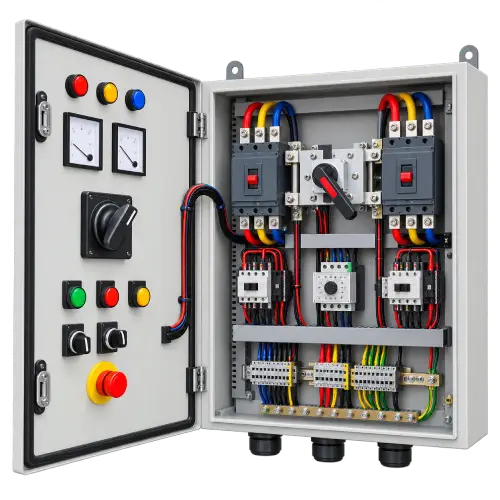
Main Components of a Changeover Panel
The internal components vary according to the current rating and transfer arrangement. Common equipment may include:
- Changeover switch
- MCCBs
- ACBs for higher-current applications
- Contactors, where appropriate
- Mechanical interlocking
- Electrical interlocking
- Control relays
- Auxiliary contacts
- Voltage monitoring relays
- Timers
- Indication lamps
- Digital meters
- Generator start/stop interface
- Terminal blocks
- Control power supply
- Busbars
- Neutral switching arrangement, where required
For automatic systems, a dedicated automatic transfer controller or suitable control logic may be incorporated.
Technical Specification Chart
The following is a general reference chart. Actual ratings should be selected according to the connected load, source characteristics and applicable electrical design.
|
Parameter |
Typical Option |
|
Product |
Manual / Auto Changeover Panel |
|
Number of Sources |
2 Sources commonly |
|
System |
Single Phase / Three Phase |
|
Common LV System |
230V / 415V AC |
|
Frequency |
50 Hz |
|
Switching Device |
Changeover Switch / MCCB / ACB / Contactor |
|
Operating Mode |
Manual / Automatic |
|
Current Rating |
Application dependent |
|
Control Voltage |
24V DC / 110V / 230V AC/DC, as required |
|
Source Monitoring |
Voltage / Phase / Frequency, as applicable |
|
Generator Interface |
Optional / Application dependent |
|
Interlocking |
Mechanical / Electrical / Both |
|
Metering |
V / A / Hz / Energy, where required |
|
Indication |
Source Available / Load on Source / Fault |
|
Enclosure |
Fabricated Sheet Steel |
|
Mounting |
Wall Mounted / Floor Standing |
|
Cable Entry |
Top / Bottom |
|
Installation |
Indoor / Outdoor |
|
Enclosure Protection |
Selected according to site conditions |
Why Interlocking Is Important
- A changeover system must be designed to prevent an inappropriate connection between independent sources.
- For example, utility power and generator power should not be connected together unless the complete system has specifically been engineered for synchronised or closed-transition operation.
- Depending on the design, mechanical and/or electrical interlocking can be incorporated to control the switching sequence.
- This is one of the most important design considerations when selecting a Changeover Panel.
Changeover Panels for Generator Applications
One of the most common applications is switching between mains electricity and a standby diesel generator. A Manual Changeover Panel allows an operator to manage this transfer manually. An Auto Changeover Panel can be integrated with the generator’s control system so that the generator can be started when the primary supply fails and the load can subsequently be transferred once the backup source reaches acceptable operating conditions.
The generator and changeover equipment must be properly matched for:
- Rated current
- Voltage
- Frequency
- Phase configuration
- Neutral arrangement
- Short-circuit conditions
- Generator control interface
- Transfer sequence
Where Changeover Panels Are Used
- Industrial Facilities
For maintaining power to selected machinery and essential plant services.
- Commercial Buildings
Useful for offices, retail properties, hotels and other facilities with standby generation.
- Hospitals & Healthcare Facilities
Can be incorporated into electrical systems where continuity of selected loads is important, subject to the facility’s specific electrical design.
- Residential Buildings
Manual or automatic changeover arrangements can be used with suitable backup power systems.
- Educational Institutions
Suitable for switching essential lighting, equipment and other selected loads to backup supply.
- Factories & Workshops
Can transfer selected industrial loads between utility and standby sources.
- Infrastructure Projects
Useful wherever an alternative electrical source needs to be connected to designated loads.
Choosing Between Manual and Automatic Changeover
A Manual Changeover Panel may be suitable when:
- An operator is readily available
- Brief power interruption is acceptable
- The installation is relatively simple
- Budget and simplicity are priorities
An Auto Changeover Panel may be preferable when:
- Backup power needs to become available without manual intervention
- The facility operates continuously
- Critical loads require faster restoration
- Generator start/stop automation is required
- Remote or unattended operation is desirable
The choice should ultimately be based on the criticality of the load and the overall electrical system design.
Construction Features
A Changeover Panel can be manufactured according to the selected switching equipment and installation conditions.
Possible construction features include:
- Robust sheet-steel enclosure
- Copper/aluminium busbars
- Clearly identified source terminals
- Separate cable chambers
- Mechanical interlocking provisions
- Electrical interlocking circuits
- Control wiring with identification
- Neutral and earth arrangements
- Source-status indication
- Removable gland plates
- Suitable protective surface finish
- Provision for future modifications
Quality & Testing
Before commissioning, a Changeover Panel should be checked for proper wiring, switching operation and source interlocking.
Depending on the configuration, testing may include:
- Visual inspection
- Wiring continuity
- Insulation checks
- Earth continuity
- Manual operating test
- Automatic transfer test
- Source sensing verification
- Interlock verification
- Generator start/stop signal test
- Indication verification
- Functional sequence testing
The applicable standards and testing requirements depend on the type of switching equipment and complete assembly.
Why Choose Sohum Industrial Sales Corporation?
Sohum Industrial Sales Corporation supplies Changeover Panels for applications requiring controlled switching between primary and alternate electrical sources.
The company caters to both Manual Changeover Panels and Auto Changeover Panels, with configurations selected according to source type, current rating, load characteristics, generator integration and operating requirements.
Customers across West Bengal, Kolkata, Odisha, Chhattisgarh, Bihar, Arunachal Pradesh, Assam, Manipur, Meghalaya, Mizoram, Nagaland, Tripura and Bhutan can approach the company for project-specific Changeover Panel requirements.
A Smarter Way to Manage Alternate Power Sources
A Changeover Panel provides the link between an electrical load and its available power sources. While a manual arrangement gives the operator direct control, an automatic arrangement can monitor the sources and execute a programmed transfer sequence.
Selecting the right system therefore depends on load criticality, source capacity, switching current, generator compatibility, transfer requirements and the desired level of automation.
For Manual and Auto Changeover Panels, Sohum Industrial Sales Corporation offers application-oriented solutions for residential, commercial, industrial and infrastructure requirements.


